The short version
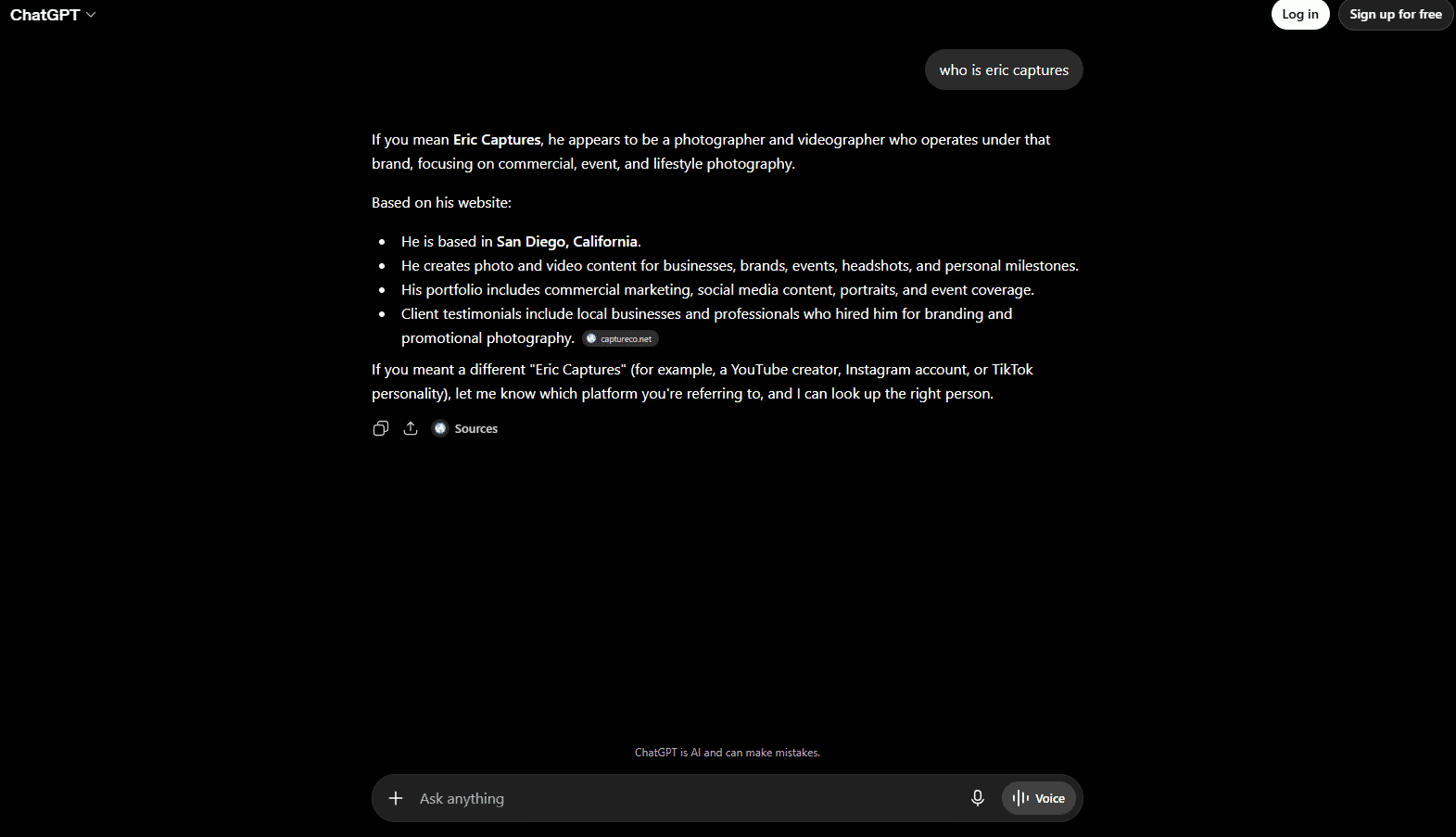
- Problem: AI search answered "who is eric captures" with a retired brand, old positioning, and the wrong domain.
- Fix: a connected JSON-LD
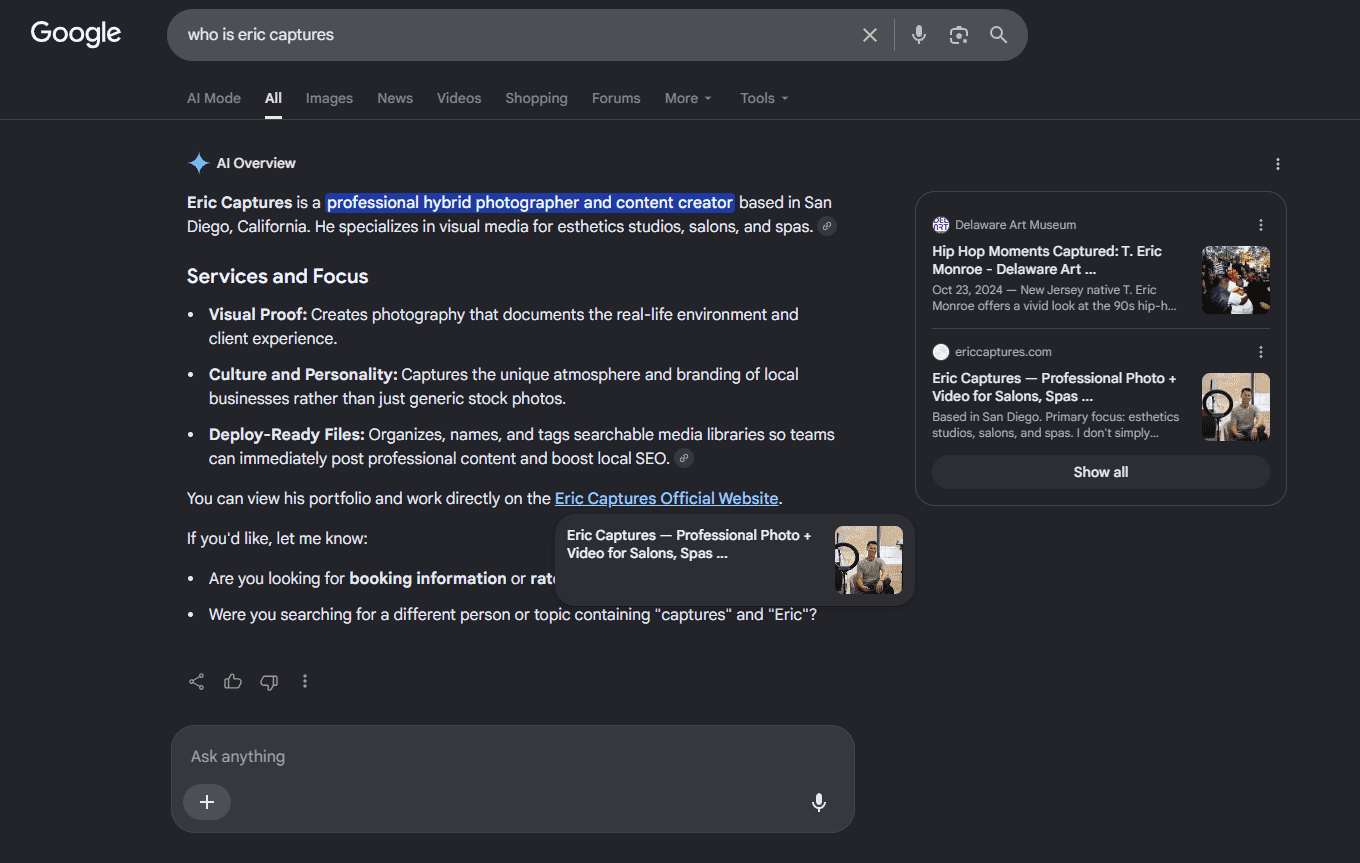
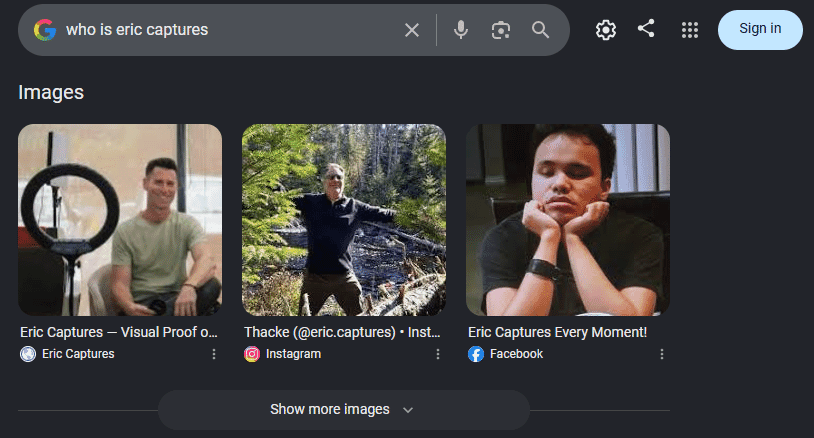
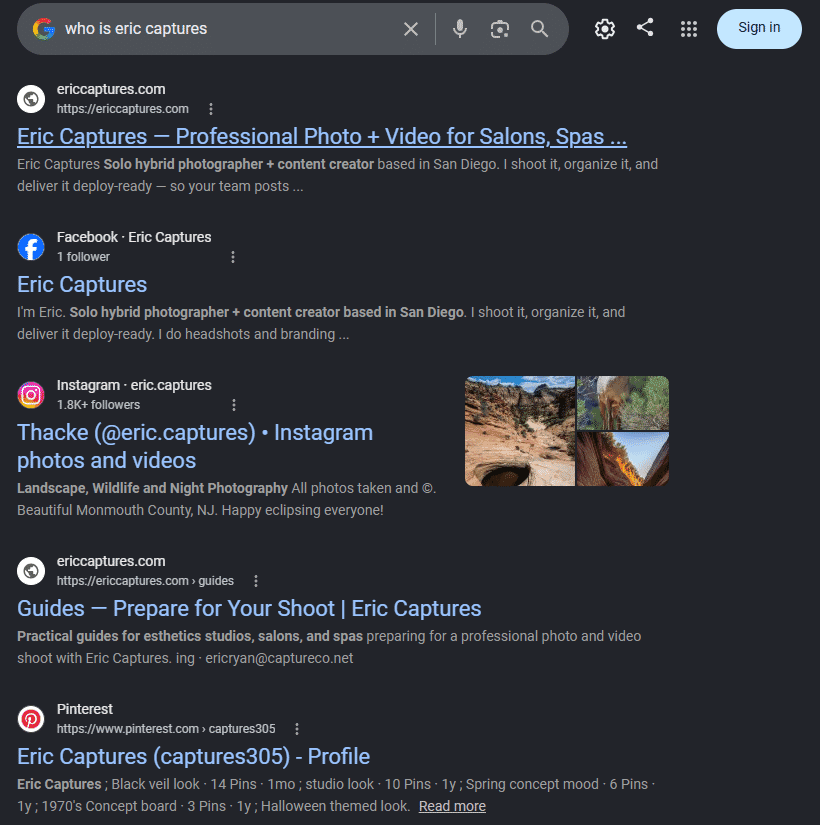
@graph, an explicit AI-crawler policy, IPTC provenance baked into every image, a verified Google Business Profile, and one consolidated identity across every platform. - Result (verifiable): Google now answers correctly — AI Overview, organic result #1, and my own copyrighted image ranked #1 in Google Images — confirmed in incognito, so it isn't personalization.
- Honest frontier: ChatGPT/Bing still lag, and a cluster of same-name photographers muddies the edges. The levers to close that gap are in flight.
The problem: AI was confidently describing the wrong business
Buyers increasingly vet a business by asking an AI engine before they ever load the website. When they asked about mine, the answer was wrong — and wrong in a way that actively cost trust. It described an outdated, generic "commercial, event, and lifestyle" photographer and cited a retired domain as its source, instead of the current San Diego business focused on esthetics studios, salons, and spas.
The diagnosis: fragmented signals, no source of truth
AI answers are only as good as the signals an engine can extract and reconcile. Mine were fragmented:
- A retired domain still winning the brand association, with more history behind it than the current site.
- No single machine-extractable source of truth — no connected entity model an engine could lift wholesale.
- Images with no provenance — nothing in the files said who made them or who to credit.
- Inconsistent social handles colliding with a cluster of other photographers who share the name.
The intervention: make the right answer the easiest one to extract
You don't argue with an AI engine; you give it a cleaner, better-connected source and make the correct answer the path of least resistance. Four moves.
1 · A connected entity graph
A single JSON-LD @graph that ties the business, the founder, the service, the offers, and the reviews together by @id — one machine-readable object an engine can lift as a unit, instead of guessing from scattered page text.
<head>
"@graph": [
  { "@type": ["ProfessionalService","PhotographyBusiness"],
    "@id": "…/#business",
    "name": "Eric Captures",
    "areaServed": { "@type": "City", "name": "San Diego" },
    "founder":   { "@id": "…/#eric" },
    "makesOffer":[{ "@id": "…/#offer-social" },{ "@id": "…/#offer-web" }],
    "sameAs": [ "…/instagram.com/ericcapturessd",
                "…/facebook.com/ericcapturessd",
                "…/github.com/ericcaptures" ] },
  { "@type": "Person", "@id": "…/#eric", "name": "Eric Ryan",
    "worksFor": { "@id": "…/#business" } },
  { "@type": "Service", "@id": "…/#service",
    "provider": { "@id": "…/#business" } }
]
2 · An explicit AI-crawler policy
Most sites leave AI crawlers to guess. I named them and welcomed them in robots.txt — the bots that actually drive AI citations get an explicit green light.
/robots.txt
User-agent: GPTBot          # OpenAI
Allow: /
User-agent: OAI-SearchBot
Allow: /
User-agent: ClaudeBot       # Anthropic
Allow: /
User-agent: PerplexityBot   # Perplexity
Allow: /
User-agent: Google-Extended # Google AI
Allow: /
User-agent: bingbot         # Microsoft / Bing AI
Allow: /
3 · Provenance baked into every image
Every delivered file carries synced IPTC/XMP written with exiftool — creator, credit, copyright, a licensor URL, and descriptive keywords. So even when an image travels, it still says who made it and points home. (It's the same layer I sell as Web Bank.)
exiftool readout on a delivered file
Creator            : Eric Captures
Credit             : Eric Captures
Copyright          : © 2026 Eric Captures. All rights reserved.
Web Statement      : https://ericcaptures.com/
Licensor URL       : https://ericcaptures.com/
Creator Work URL   : https://ericcaptures.com
Alt Text (Access.) : Staff applying skincare product at a San Diego esthetics studio
Keywords           : esthetics, treatment, san diego
4 · One entity across every surface
Signals only reinforce each other when they match. I stood up a verified Google Business Profile with a name/URL identical to the homepage graph, and — because a common name collides with other photographers — I consolidated to a single, unique handle (ericcapturessd) across Instagram and Facebook, so the same string repeats everywhere and out-signals the same-name accounts.
The receipts: Google adopted the corrected entity
Answer first: Google now describes the business correctly, and it isn't personalization — the same corrected answer shows up in a clean incognito window with no history. Better still, Google started quoting the site's own copy back ("hybrid photographer and content creator," "deploy-ready") — proof the graph and copy are being machine-extracted, not paraphrased from stale cache.
What's still in progress (because honesty is the point)
A real GEO project isn't a light switch — different engines update on different clocks, and I'd rather show you the true state than a cherry-picked win.
- ChatGPT / Bing lag. ChatGPT search runs on Bing's index plus model memory, and it hasn't re-crawled yet — so it still shows the old answer. The levers: Bing Webmaster Tools + IndexNow to force a re-crawl, and purging the last legacy-email signal from off-site profiles. Google moved first; Bing follows.
- A same-name cluster. "Eric" + "Captures" is a common pairing, so several other photographers surface around the edges of image and social results. You can't delete other people's accounts — you out-signal them, which is exactly why the handle consolidation above matters, and why authority on the correct profiles keeps compounding.
Understanding why one engine leads and another lags — and having the specific levers for each — is the difference between doing GEO and guessing at it.
What this means for your clients
This is the exact work I run for agencies — the connected graph, the crawler policy, the image provenance, and the entity consolidation — pointed at your clients, so they're the business AI cites when a buyer asks. If a photographer can do this for himself, imagine it applied across your roster.